Time Clock Calculator
This time clock calculator subtracts clock-in from clock-out and takes off the break: 9:00 AM to 5:00 PM with a 30-minute break is 7 h 30 min, or 7.50 hours.
Sources: 29 CFR 785.48, 29 CFR 785.19 Updated
Result
9:00 AM to 5:00 PM, 30 min break = 7 h 30 min
= 7.50 hours as a decimal
How the time clock calculator works out hours
hours worked = (clock out − clock in − break) ÷ 60, with times in minutes
Clock times cannot be subtracted like ordinary decimals, because an hour has 60 minutes, not 100. The calculator converts each time to minutes after midnight, does the subtraction there, and converts the result back.
Times can be typed as 17:00 or 5:00 PM; the 24-hour to 12-hour converter shows how the two match. The decimal to time converter turns a decimal total back into hours and minutes.
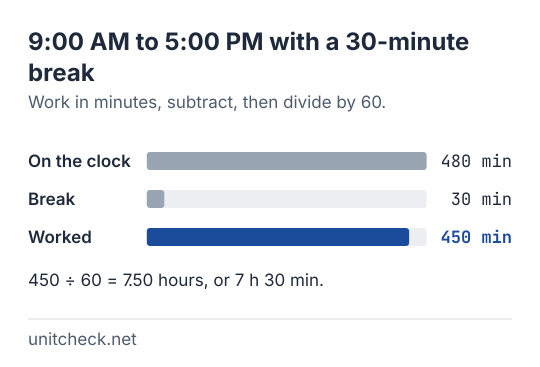
How to calculate hours worked: 9:00 AM to 5:00 PM with a 30-minute break
- Clock in at 9:00 is 9 × 60 = 540 minutes after midnight. Clock out at 17:00 is 17 × 60 = 1,020.
- Time on the clock: 1,020 − 540 = 480 minutes.
- Take off the break: 480 − 30 = 450 minutes.
- 450 ÷ 60 = 7.5 hours, or 7 h 30 min.
Minutes as decimal hours
Use this to turn the minutes of a shift into the decimal a timesheet wants. The minutes to hours converter does the same for any number of minutes.
| min | hours |
|---|---|
| 1 | 0.02 |
| 2 | 0.03 |
| 3 | 0.05 |
| 4 | 0.07 |
| 5 | 0.08 |
| 6 | 0.10 |
| 7 | 0.12 |
| 8 | 0.13 |
| 9 | 0.15 |
| 10 | 0.17 |
| 11 | 0.18 |
| 12 | 0.20 |
| 13 | 0.22 |
| 14 | 0.23 |
| 15 | 0.25 |
| min | hours |
|---|---|
| 16 | 0.27 |
| 17 | 0.28 |
| 18 | 0.30 |
| 19 | 0.32 |
| 20 | 0.33 |
| 21 | 0.35 |
| 22 | 0.37 |
| 23 | 0.38 |
| 24 | 0.40 |
| 25 | 0.42 |
| 26 | 0.43 |
| 27 | 0.45 |
| 28 | 0.47 |
| 29 | 0.48 |
| 30 | 0.50 |
| min | hours |
|---|---|
| 31 | 0.52 |
| 32 | 0.53 |
| 33 | 0.55 |
| 34 | 0.57 |
| 35 | 0.58 |
| 36 | 0.60 |
| 37 | 0.62 |
| 38 | 0.63 |
| 39 | 0.65 |
| 40 | 0.67 |
| 41 | 0.68 |
| 42 | 0.70 |
| 43 | 0.72 |
| 44 | 0.73 |
| 45 | 0.75 |
| min | hours |
|---|---|
| 46 | 0.77 |
| 47 | 0.78 |
| 48 | 0.80 |
| 49 | 0.82 |
| 50 | 0.83 |
| 51 | 0.85 |
| 52 | 0.87 |
| 53 | 0.88 |
| 54 | 0.90 |
| 55 | 0.92 |
| 56 | 0.93 |
| 57 | 0.95 |
| 58 | 0.97 |
| 59 | 0.98 |
| 60 | 1.00 |
For a whole week of shifts, use the work hours calculator.
Time Clock Calculator: FAQ
How do I calculate hours worked?
Turn both times into minutes after midnight, subtract the start from the end, take off the break and divide by 60. From 9:00 (540 minutes) to 17:00 (1,020 minutes) is 480 minutes; minus a 30 minute break leaves 450 minutes, which is 7.5 hours.
Why is 7 hours 30 minutes written as 7.50 and not 7.30?
Payroll uses decimal hours, where the part after the point is a fraction of an hour, not a number of minutes. 30 minutes is half an hour, so 7 h 30 min is 7.50 hours. 7.30 hours would be 7 h 18 min.
Does it work for night shifts?
Yes. If the clock-out time is the same as or earlier than the clock-in time, the calculator takes it to be on the next day. 10:00 PM to 6:00 AM is 8 hours.
What does the rounding option do?
It rounds the time worked to the nearest 5, 6 or 15 minutes. Six minutes is a tenth of an hour and 15 minutes a quarter, the steps many timesheets use.
In the United States, 29 CFR 785.48 accepts rounding to those steps as long as, over time, employees are paid for all the time they work. Your employer and local law set the rule that applies to you.
Is the break paid or unpaid?
The calculator simply subtracts the break you enter. If your break is paid, enter 0. Under US federal rules a meal break of 30 minutes or more is ordinarily unpaid (29 CFR 785.19), while short rest breaks count as hours worked.
Sources
- 29 CFR 785.48, Use of time clocks (eCFR) — US federal rule on rounding clock times to the nearest 5 minutes, tenth or quarter of an hour (checked October 16, 2026)
- 29 CFR 785.19, Meal (eCFR) — bona fide meal periods, ordinarily 30 minutes or more, are not worktime (checked October 16, 2026)