Cups to Grams Converter
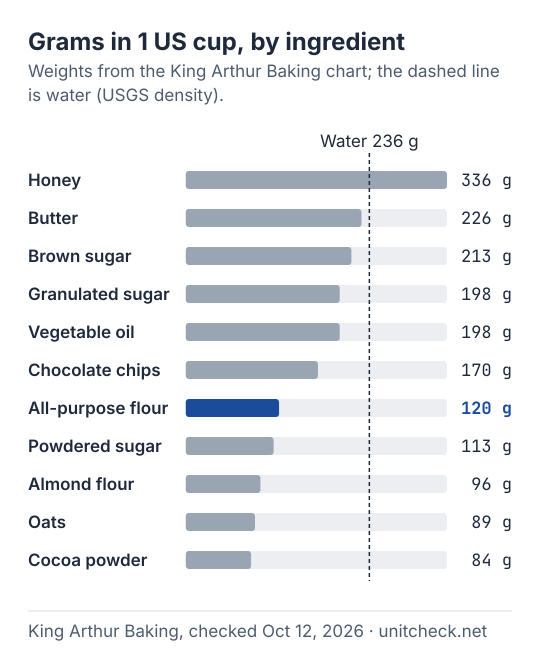
Converting cups to grams depends on the ingredient: 1 cup of all-purpose flour is 120 g, 1 cup of granulated sugar is 198 g and 1 cup of butter is 226 g. Pick one in the converter and the result shows the line its weight comes from.
Sources: King Arthur Baking, USGS, NIST SP 811, NIST Handbook 44 Updated
Result
1 cup all-purpose flour = 120 g
King Arthur Baking: 1 cup = 120 g (checked 2026-10-12)
Cups to grams formula
Cups and grams measure different things, one volume and the other weight. The link between them is how much a given volume of the ingredient weighs, and that is different for every ingredient. The converter looks the weight up in the King Arthur Baking ingredient weight chart and does the rest exactly.
grams = amount × grams per cup of the ingredient
How to convert 1 1/2 cups of granulated sugar to grams
- Look up the ingredient: granulated sugar is listed as 1 cup = 198 g, which is 198 g per cup.
- Multiply by the amount: 1 1/2 cups × 198 g = 297 g.
Cups to grams by ingredient
38 ingredients. The last column shows the line each weight was taken from, so you can check it against the source.
| Ingredient | 1/4 cup | 1/3 cup | 1/2 cup | 2/3 cup | 3/4 cup | 1 cup | Listed by the source as |
|---|---|---|---|---|---|---|---|
| All-purpose flour | 30 | 40 | 60 | 80 | 90 | 120 | 1 cup = 120 g (King Arthur Baking) |
| Bread flour | 30 | 40 | 60 | 80 | 90 | 120 | 1 cup = 120 g (King Arthur Baking) |
| Whole wheat flour | 28.3 | 37.7 | 56.5 | 75.3 | 84.8 | 113 | 1 cup = 113 g (King Arthur Baking) |
| Cake flour (unbleached) | 30 | 40 | 60 | 80 | 90 | 120 | 1 cup = 120 g (King Arthur Baking) |
| Pastry flour | 26.5 | 35.3 | 53 | 70.7 | 79.5 | 106 | 1 cup = 106 g (King Arthur Baking) |
| Self-rising flour | 28.3 | 37.7 | 56.5 | 75.3 | 84.8 | 113 | 1 cup = 113 g (King Arthur Baking) |
| Rye flour (medium) | 26.5 | 35.3 | 53 | 70.7 | 79.5 | 106 | 1 cup = 106 g (King Arthur Baking) |
| Almond flour | 24 | 32 | 48 | 64 | 72 | 96 | 1 cup = 96 g (King Arthur Baking) |
| Semolina flour | 40.8 | 54.3 | 81.5 | 109 | 122 | 163 | 1 cup = 163 g (King Arthur Baking) |
| Cornmeal (whole) | 34.5 | 46 | 69 | 92 | 104 | 138 | 1 cup = 138 g (King Arthur Baking) |
| Cornstarch | 28 | 37.3 | 56 | 74.7 | 84 | 112 | 1/4 cup = 28 g (King Arthur Baking) |
| Granulated sugar | 49.5 | 66 | 99 | 132 | 149 | 198 | 1 cup = 198 g (King Arthur Baking) |
| Brown sugar (packed) | 53.3 | 71 | 107 | 142 | 160 | 213 | 1 cup = 213 g (King Arthur Baking) |
| Powdered sugar (unsifted) | 28.3 | 37.7 | 56.5 | 75.3 | 84.8 | 113 | 1 cup = 113 g (King Arthur Baking) |
| Honey | 84 | 112 | 168 | 224 | 252 | 336 | 1 tablespoon = 21 g (King Arthur Baking) |
| Maple syrup | 78 | 104 | 156 | 208 | 234 | 312 | 1/2 cup = 156 g (King Arthur Baking) |
| Molasses | 85 | 113 | 170 | 227 | 255 | 340 | 1/4 cup = 85 g (King Arthur Baking) |
| Corn syrup | 78 | 104 | 156 | 208 | 234 | 312 | 1 cup = 312 g (King Arthur Baking) |
| Butter | 56.5 | 75.3 | 113 | 151 | 170 | 226 | 1/2 cup = 113 g (King Arthur Baking) |
| Vegetable oil | 49.5 | 66 | 99 | 132 | 149 | 198 | 1 cup = 198 g (King Arthur Baking) |
| Olive oil | 50 | 66.7 | 100 | 133 | 150 | 200 | 1/4 cup = 50 g (King Arthur Baking) |
| Coconut oil | 56.5 | 75.3 | 113 | 151 | 170 | 226 | 1/2 cup = 113 g (King Arthur Baking) |
| Vegetable shortening | 46 | 61.3 | 92 | 123 | 138 | 184 | 1/4 cup = 46 g (King Arthur Baking) |
| Peanut butter | 67.5 | 90 | 135 | 180 | 203 | 270 | 1/2 cup = 135 g (King Arthur Baking) |
| Rice (long grain, dry) | 49.5 | 66 | 99 | 132 | 149 | 198 | 1/2 cup = 99 g (King Arthur Baking) |
| Oats (old-fashioned or quick-cooking) | 22.3 | 29.7 | 44.5 | 59.3 | 66.8 | 89 | 1 cup = 89 g (King Arthur Baking) |
| Cocoa powder (unsweetened) | 21 | 28 | 42 | 56 | 63 | 84 | 1/2 cup = 42 g (King Arthur Baking) |
| Chocolate chips | 42.5 | 56.7 | 85 | 113 | 128 | 170 | 1 cup = 170 g (King Arthur Baking) |
| Raisins (loose) | 37.3 | 49.7 | 74.5 | 99.3 | 112 | 149 | 1 cup = 149 g (King Arthur Baking) |
| Walnuts (chopped) | 28.3 | 37.7 | 56.5 | 75.3 | 84.8 | 113 | 1 cup = 113 g (King Arthur Baking) |
| Breadcrumbs (dried) | 28 | 37.3 | 56 | 74.7 | 84 | 112 | 1/4 cup = 28 g (King Arthur Baking) |
| Table salt | 72 | 96 | 144 | 192 | 216 | 288 | 1 tablespoon = 18 g (King Arthur Baking) |
| Kosher salt (Diamond Crystal) | 32 | 42.7 | 64 | 85.3 | 96 | 128 | 1 tablespoon = 8 g (King Arthur Baking) |
| Kosher salt (Morton) | 64 | 85.3 | 128 | 171 | 192 | 256 | 1 tablespoon = 16 g (King Arthur Baking) |
| Baking powder | 48 | 64 | 96 | 128 | 144 | 192 | 1 teaspoon = 4 g (King Arthur Baking) |
| Baking soda | 72 | 96 | 144 | 192 | 216 | 288 | 1/2 teaspoon = 3 g (King Arthur Baking) |
| Instant yeast | 36 | 48 | 72 | 96 | 108 | 144 | 1 tablespoon = 9 g (King Arthur Baking) |
| Water | 59 | 78.7 | 118 | 157 | 177 | 236 | 1 milliliter = 0.99802 g (USGS) |
Ingredient weights: King Arthur Baking ingredient weight chart, checked October 12, 2026. Water: U.S. Geological Survey. US customary cup (236.59 mL) and tablespoon (14.79 mL). unitcheck.net/cooking/cups-to-grams/
Ingredients missing from the cups to grams table
An ingredient is only listed when its weight could be checked in a named source. Milk, cream and yogurt are missing because the chart we use rounds them to 8 ounces per cup, which is about 4% light for water.
If your ingredient is not listed, the converter will not guess. Use a recipe that gives weights, or weigh one level cup yourself. For a liquid, convert by volume with cups to milliliters, or use the milliliters to grams converter with a density you know.
Going the other way? Use the grams to cups converter. The cooking converter handles every kitchen measure, and its chart lists one cup of each ingredient in grams.
Cups to Grams Converter: FAQ
How many grams are in a cup?
It depends on the ingredient, because a cup measures volume and a gram measures weight. 1 cup of all-purpose flour is 120 g, 1 cup of granulated sugar is 198 g and 1 cup of butter is 226 g. Pick the ingredient in the converter to get its figure.
Why is there no single conversion factor?
Grams measure weight and cups measure volume. How much a cup weighs depends on how dense the ingredient is and how it is packed: a cup of honey weighs 2.8 times as much as a cup of flour. A converter that gives one answer for every ingredient is wrong for most of them.
Where do the ingredient weights come from?
From the King Arthur Baking ingredient weight chart, checked on October 12, 2026. The table on this page shows the line each figure was taken from. Water uses the density published by the U.S. Geological Survey (0.99802 g/mL at 21 °C).
How accurate are the results?
The arithmetic is exact, but a measured cup is not. A cup that is packed or heaped holds more than one that is filled loosely and levelled, so yours may not weigh what the chart says.
Treat the result as a good starting figure. When a recipe gives weights, weighing is more reliable than converting.
Why are milk and cream not in the list?
The source chart lists water, milk, cream and yogurt at a rounded 8 ounces (227 g) per cup. A US cup of water actually weighs about 236 g, so those lines are about 4% low.
We use a measured density for water and leave the other liquids out until we can cite a checked density for each. For any liquid you can still convert by volume, for example cups to milliliters.
Which cup and tablespoon does this use?
US customary measures: 1 cup = 236.5882 mL and 1 tablespoon = 14.7868 mL (NIST Handbook 44).
Is 1 cup of flour 150 g?
Not with the US cup used here. By the King Arthur chart a cup of all-purpose flour is 120 g, so 150 g of it is 1.25 cups (1 1/4 cups). A cup measures volume, so its weight depends on the ingredient: loose raisins come to about 150 g a cup (149 g), granulated sugar to 198 g, and a cup of water is 236 g, not 250 g.
Sources
- King Arthur Baking: Ingredient Weight Chart — weights measured in King Arthur's test kitchen; a practical baking reference, not a laboratory density table (checked October 12, 2026)
- U.S. Geological Survey, Water Science School: Water Density — 0.99802 g/cm³ at 70 °F (21 °C) (checked October 12, 2026)
- NIST Special Publication 811, Guide for the Use of the International System of Units, Appendix B.8: Factors for Units Listed Alphabetically — exact factors are printed in bold in the NIST table (checked October 12, 2026)
- NIST Handbook 44 (2026), Appendix C: General Tables of Units of Measurement — US customary units and their exact relationships (checked October 12, 2026)